



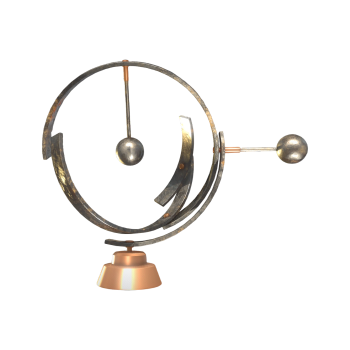
Joule Meter Principle Experiment (3D Experimental Animation)
In 1847, Joule designed a more ingenious experiment by placing water in a calorimeter, installing a rotating shaft with blades in the middle, and then letting a descending weight drive the blades to rotate. Due to the friction between the blades and water, both the water and the calorimeter heated up. Based on the height of the heavy object falling, the converted mechanical work can be calculated; Based on the temperature rise of water in the calorimeter, the increase in internal energy of water can be calculated. By comparing two numbers, the accurate value of thermal energy equivalent can be obtained.

Popular Models

Random Model


Flat iron at the Stranraer Museum
625 View

Volkswagen Worker4X4EB Heavy Truck
730 View
Grey Wolf (Male) 3D Model Animation
781 View
Red Women's Hand Bag
775 View

Crocodile 3D model animation glb
862 View


Balloon Puppy
947 View

Xiaomi SU7 electric SUV
1456 View